

.webp)
You’re on your third “finalist” city with a half-finished spreadsheet and a reminder to “decide next week.” Then work gets busy, a good listing disappears, and somehow the decision moves to next month. If you’re investing from out of state, that limbo is normal, but it’s also costly.
Every week you stay stuck in research mode is a week you’re not building income, learning the market, or creating deal flow.
This is Part 1 of a five-part series focused on Philadelphia, designed to break that cycle with a practical, repeatable approach. You’ll choose a strategy lane that fits your risk and schedule, write a clear buy box, and use a simple submarket lens so you can stop browsing and start buying with confidence.
Key Takeaways
- Philadelphia is a set of micro-markets, so choose your strategy lane before choosing neighborhoods.
- A one-page buy box turns browsing into fast, repeatable yes-or-no decisions.
- A simple scorecard keeps you consistent and prevents hype-driven purchases.
- Remote investors win by avoiding mismatches, especially heavy rehab without trusted local execution.
Why Philadelphia Deserves a Serious Look
You don’t need a thick market report to get started. You need a simple reason that fits your budget, your time, and how you plan to manage from out of state.
Philadelphia offers a deep rental pool and lots of small rental properties, especially rowhomes and 2 to 4-unit buildings. That repeatable housing stock makes it easier to standardize your inspections, rehab expectations, and reserves as you grow.
Here’s the catch: Philly changes fast from one neighborhood, and sometimes one block, to the next. Demand, property condition, and day-to-day operations can look very different nearby. So don’t ask, “Is Philly good?” Ask, “What strategy can I repeat here, and where does it work best?”
Step 1: Choose Your Investment Lane
Think of your “lane” as your default game plan. It’s the approach you can repeat deal after deal, and it makes your yes and no decisions much easier.
Lane A: Stabilized cash-flow rentals
You buy a property that’s already rentable, with little work needed right away. You’re aiming for steady rent, fewer surprises, and simpler turnovers. You may pay closer to market price, but you lower the risk of things going sideways.
Lane B: Light value-add (BRRRR-lite)
You buy something that needs improvement, but not a full gut rehab. The goal is a clear, controlled upgrade plan that raises rents and value. This lane only works when you have tight scope control and reliable contractors. A vague plan turns “small fixes” into big delays.
Lane C: Appreciation and longer holds
You accept lower cash flow today for the chance of bigger equity growth over time. Use this lane only if the deal still meets your minimum cash-flow rules without relying on appreciation to save it.
Simple rule: If you’re out of state and don’t have a trusted local operator, start with Lane A until you’ve stabilized your first property.
Now let’s turn that strategy into something you can actually use. Instead of more theory, the next three deliverables are practical tools you can copy, fill in, and reuse on every deal. They’ll help you stay consistent, compare options clearly, and avoid the common mistakes that cost out-of-state investors the most time and money.
Deliverable 1: The One-Page Buy Box Worksheet
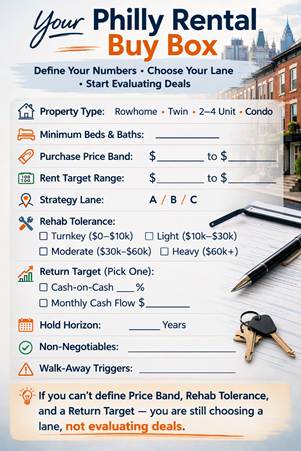
A Philadelphia-themed buy box worksheet poster that helps out-of-state investors define deal criteria before evaluating properties. It’s especially important in Philly, where conditions change block to block, because it keeps decisions consistent across micro-markets.
The worksheet covers property type, beds and baths, price and rent ranges, strategy lane, rehab tolerance, return targets, hold horizon, and walk-away triggers.
Deliverable 2: A Submarket Scorecard That Keeps You Consistent
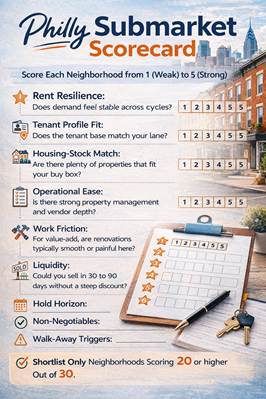
A Philadelphia-themed submarket scorecard poster that helps investors compare neighborhoods with a simple 1-to-5 rating system. It’s especially important in Philly, where block-to-block differences can change tenant demand, operating ease, and resale liquidity.
The scorecard rates rent resilience, tenant profile fit, housing-stock match, operational ease, work friction, and liquidity, and then suggests shortlisting areas that score at least 20 out of 30.
Philly Rules: Paperwork and Timing Matter
In Philadelphia, the deal is not finished when you close. You also need time to get the property “rent-ready” on paper. Most rentals require a city rental license and a few registration steps, so build room in your timeline for forms, inspections, and possible fixes before you advertise the unit. Also, plan for local tenant processes.
Philly’s Eviction Diversion Program can add steps if a tenant stops paying rent, so keep healthy reserves and maintain realistic expectations.
Deliverable 3: Avoid These Mismatches
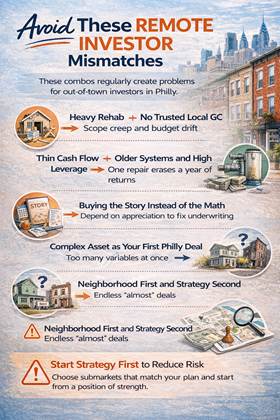
A Philadelphia-themed “Avoid These Remote Investor Mismatches” poster that highlights the most common deal combinations that derail out-of-state investors.
It’s important because Philly’s housing stock, rehab variables, and block-by-block market shifts can magnify small mistakes into costly setbacks. The visual layout makes the risks easy to spot, helping investors choose strategy first, control rehab scope, protect cash flow, and avoid “almost” deals.
FAQ
Do I need a rental license to rent out a property in Philadelphia?
Yes. Philadelphia requires a rental license for residential rental units, and you should plan for the related registration steps.
What lane is best for a first-time out-of-state investor?
Most remote investors should start with stabilized cash-flow rentals unless they already have trusted local contractors and a proven management setup.
How many neighborhoods should I focus on at once?
Start with two or three, so you learn faster, underwrite consistently, and build deal flow in the same pockets.
Turn Philly into a Repeatable System
Strong portfolios are built with fewer surprises, not more opinions. When your lane is clear, your buy box is written, and your neighborhood scorecard is consistent, decisions get faster, and results get steadier.
Your first Philly property should be the first piece of an operating system, not a one-time bet. Focus on a small set of submarkets that fit your plan, budget time for local compliance, and scale by repeating the same disciplined process.
Want that system running without you living on the phone? Innovate Realty & PM handles leasing, maintenance coordination, compliance workflows, and clean reporting so you can invest with confidence from anywhere.
Reach out to us, and we’ll help turn your criteria into a real pipeline and your first door into a portfolio!
Additional Resources
Short-Term Rentals in Philly: Rules, Risks, and Returns
Energy Efficient Upgrades That Actually Pay Off in Philadelphia Rental Properties